Minggu, 05 Juni 2016

Idioms

An idiom is a word or phrase which means something different from its literal meaning. Idioms are common phrases or terms whose meaning is not real, but can be understood by their popular use.

Because idioms can mean something different from what the words mean it is difficult for someone not very good at speaking the language to use them properly. Some idioms are only used by some groups of people or at certain times. The idiom shape up or ship out, which is like saying improve your behavior or leave if you don't, might be said by an employer or supervisor to an employee, but not to other people.

Idioms are not the same thing as slang. Idioms are made of normal words that have a special meaning known by almost everyone. Slang is usually special words that are known only by a particular group of people.

To learn a language a person needs to learn the words in that language, and how and when to use them. But people also need to learn idioms separately because certain words together or at certain times can have different meanings. In order to understand an idiom, one sometimes needs to know the culture the idiom comes from.

The Example of Idioms: 
1. Break a leg (A way to wish someone good luck)
2. To live it up (To enjoy life, to live widely)
3. To kick the bucket (To die)
4. Shape up or ship out (Used to tell someone that they should leave if they don't improve their behavior or performance)
5. To shed crocodile tears (To cry about something but without actually caring)
6. Wild goose chase (A useless journey or pursuit)
7. There's no room to swing a cat (There is not a lot of space)
8. To pay through the nose (To pay a lot of money, more than is normal)
9. To bark up the wrong tree (To choose the wrong course of action)
10. To spill the beans (To tell a secret)
11. It's raining cats and dogs (It's raining heavily)
12. To get into hot water (To get into trouble)
13. To be chicken-hearted (To be scared)
14. Top dog (Leader)
15. To smell a rat (To think that something is wrong)
16. To chicken out (Not doing an activity because of fear)
17. To give up (To quit)
18. To give up on (To stop believing in something or someone)
19. I could eat a horse (To be very hungry)
20. To be on top of the world  (To be really happy)

Proverb

 
English and American proverbs are almost second nature when delivered. The origins are quite often little known, yet the expressions are popular. Ethnic proverbs, on the other hand, may be a little deeper to digest, and require non-natives of the proverb’s country of origin, to think about the meaning in order to better understand how it applies to their lives.

What is a proverb?
A proverb is most often a phrase or saying that gives advice in an obscure way. The phrase usually has an allegorical type of message behind that when first heard may seem a little odd. Usually a proverb is very well known because of its popular use in colloquial language.

Role of Proverbs in Society
 Proverbs play many roles in society. The first, possibly, most common role that a proverb plays is to educate. Most often tossed around as expert advice in conversation, the innate role to educate people on what might happen if they do something.

Think of a proverb as a little tidbit of wisdom that just about everyone no matter where they are from can offer. There is a proverb for just about every circumstance, and proverbs can be applied to any situation.

English and American proverbs are almost second nature when delivered. The origins are quite often little known, yet the expressions are popular. Ethnic proverbs, on the other hand, may be a little deeper to digest, and require non-natives of the proverb’s country of origin, to think about the meaning in order to better understand how it applies to their lives.

 English Proverbs
Some examples of English proverbs include:
1. Actions speaks louder than word.
Meaning: What you do is more important than what you say.
Example: Don't just tell me you're going to change. Do it! Actions speak louder than word.
2. All good things must come to an end.
Meaning: Everything ends; good times don't last forever.
Example: I wish this vacation would go on forever. It's too bad that all good things must come to an end.
3. A picture is worth a thousand words.
Meaning: An image can tell a story better than word.
Example: I wasn't sure that he loved her, but then I saw them hugging at their airport. A picture is  worth a thousand words.
4. A watched pot never boils. 
Meaning: If something takes time to do, it doesn't help to constantly check on it. You just have to give it time.
Example: I know you think he's going to be a great guitar player one day, but stop criticizing him so much. He just started taking lesson two weeks ago! A watched pot never boils.
5. Beauty is in the eye of the beholder.
Meaning: what is "beautiful" is different for each person.
Example: I think their house is ugly, but they seem to like it. Beauty is in the eye of beholder. 

Homonyms, Homophones, and Homographs

The words homonym, homophone, and homograph are grammatical terms that are easy to confuse with one another because their meanings are all closely related, so let’s go through each one of them and see what the differences are.
  • A homograph is a word that has the same spelling as another word but has a different sound and a different meaning.
Examples:
*lead (to go in front of) / lead (a metal)
*wind (to follow a course that is not straight) / wind (a gust of air)
*bass (low, deep sound) / bass (a type of fish)
  • A homophone is a word that has the same sound as another word but is spelled differently and has a different meaning.
Examples:
to / two / too
there / their / they're
pray / prey
  •  A homonym is one of a group of words that share the same pronunciation but have different meanings, whether spelled the same or not.
Examples:
A further example of a homonym, which is both a homophone and a homograph, is fluke. Fluke can mean:
  1. A fish, and a flatworm.
  2. The end parts of an anchor.
  3. The fins on a whale's tail.
  4. A stroke of luck.
 These meanings represent at least three etymologically separate lexemes, but share the one form, fluke. Similarly, a river bank, a savings bank, a bank of switches, and a bank shot in pool share a common spelling and pronunciation, but differ in meaning.

The words bow and bough are examples where there are two meanings associated with a single pronunciation and spelling (the weapon and the knot); two meanings with two different pronunciations (the knot and the act of bending at the waist), and two distinct meanings sharing the same sound but different spellings (bow, the act of bending at the waist, and bough, the branch of a tree). 

In addition, it has several related but distinct meanings: a bent line is sometimes called a 'bowed' line, reflecting its similarity to the weapon. Even according to the most restrictive definitions, various pairs of sounds and meanings of bow, Bow and bough are homonyms, homographs, homophones, heteronyms, heterographs, capitonyms and are polysemous.


Senin, 30 Mei 2016

Hyperbole

Hyperbole Definition

Hyperbole, derived from a Greek word meaning “over-casting” is a figure of speech, which involves an exaggeration of ideas for the sake of emphasis.
An hyperbole is an exaggeration which may be used for emphasis and humor. Hyperboles are used in speaking and writing for effect or to make a boring story more interesting.
It is a device that we employ in our day-to-day speech. For instance, when you meet a friend after a long time, you say, “Ages have passed since I last saw you”. You may not have met him for three or four hours or a day, but the use of the word “ages” exaggerates this statement to add emphasis to your wait.  Therefore, a hyperbole is an unreal exaggeration to emphasize the real situation. Some other common Hyperbole examples are given below.

Common Examples of Hyperbole

  1. My grandmother is as old as the hills.
  2. Your suitcase weighs a ton!
  3. She is as heavy as an elephant!
  4. I am dying of shame.
  5. I am trying to solve a million issues these days. 

Hyperbole Examples for Children

  • It was so cold I saw polar bears wearing jackets.
  • I am so hungry I could eat a horse.
  • I had a ton of chores to do.
  • If I can’t get a Smartphone, I will die.
  • She is as thin as a toothpick.
  • This car goes faster than the speed of light.
  • Our new house cost a bazillion dollars.
  • We are poor and don’t have two cents to rub together.
  • The car is as fast as greased lightning.
  • He's got tons of video games.
  • You could have knocked me over with a feather.
  • Her brain is the size of a pea.
  • Grandpa is older than dirt.
  • My mom is going to kill me.
  • Old Mr. Smith has been teaching here since the Stone Age.
It is important not to confuse hyperbole with simile and metaphor. It does make a comparison but unlike simile and metaphor, hyperbole has a humorous effect created by an overstatement.

Function of Hyperbole

The above arguments make clear the use of hyperbole. In our daily conversation, we use hyperbole to emphasize for an amusing effect. However, in literature it has very serious implications. By using hyperbole, a writer or a poet makes common human feelings remarkable and intense to such an extent that they do not remain ordinary. In literature, usage of hyperbole develops contrasts. When one thing is described with an over-statement and the other thing is presented normally, a striking contrast is developed. This technique is employed to catch the reader’s attention.


Polysemy

 
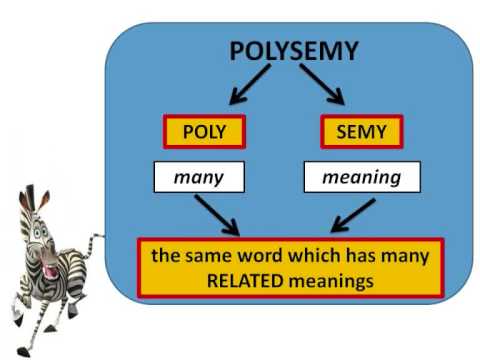
Polysemy is the association of one word with two or more distinct meanings.
A polyseme is a word or phrase with multiple meanings. 
Adjective: polysemous or polysemic.

In contrast, a one-to-one match between a word and a meaning is called monosemy. 
Homonymy is the relation between words with identical forms but different meanings that is, the condition of being homonyms. A stock example is the word bank as it appears in "river bank" and "savings bank." 

Homonymy and polysemy both involve one lexical form that is associated with multiple senses and as such both are possible sources of lexical ambiguity. But while homonyms are distinct lexemes that happen to share the same form, in polysemy a single lexeme is associated with multiple senses. The distinction between homonymy and polysemy is usually made on the basis of the relatedness of the senses: polysemy involves related senses, whereas the senses associated with homonymous lexemes are not related.

Examples of polysemy:

Man
1. The human species (i.e., man vs. animal).
2. Males of the human species ( i.e., man vs. woman).
3. Adult males of the human species (i.e., man vs. woman).
This example shows the specific polysemy where the same word is used at different levels of a taxonomy. Example 1 contains 2, and 2 contains 3.
Mole 
1. A small burrowing mammal.
2. Consequently, there are several different entities called moles. Although these refer to different      things, there names derive from 1. :e.g. A mole burrows for information hoping to go undetected. 
 
Bank 
1. A financial institution.
2. The building where a financial institution offers services.
3. A synonym for 'rely upon' (e.g. "I'm your friend, you can bank on me"). It is different, but related, as it derives from the theme of security initiated by 1. 
However: a river bank is a homonym to 1 and 2, as they do not share etymologies. It is a completely different meaning. River bed, though, is polysemous with the beds on which people sleep.
Book 
1. A bound collection of pages.
2. A text reproduced and distributed (thus, someone who has read the same text on a computer has read the same book as someone who had the actual paper volume).
3. To make an action or event a matter of record (e.g. "Unable to book a hotel room, a man sneaked into a nearby private residence where police arrested him and later booked him for unlawful entry.").

Newspaper 
1. A company that publishes written news. 
2. A single physical item published by the company. 
3. The newspaper as an edited work in a specific format (e.g. "They changed the layout of the newspaper's front page"). 
The different meanings can be combined in a single sentence, e.g. "John used to work for the newspaper that you are reading."
Milk 
The verb milk (e.g. "he's milking it for all he can get") derives from the process of obtaining milk.

Wood 
1. A piece of a tree.
2. A geographical area with many trees.
 
Crane
1. A bird.
2. A type of construction equipment.
3. To strain out one's neck.

Senin, 16 Mei 2016

Metonymy and Synecdoche


Definition of Metonymy
 
 
 Metonymies are frequently used in literature and in everyday speech. A metonymy is a word or phrase that is used to stand in for another word. Sometimes a metonymy is chosen because it is a well-known characteristic of the word.
One famous example of metonymy is the saying, "The pen is mightier than the sword," which originally came from Edward Bulwer Lytton's play Richelieu. This sentence has two examples of metonymy:
Ø The "pen" stands in for "the written word."
Ø The "sword" stands in for "military aggression and force."


A Word Functioning as a Metonymy

Understanding the context of a metonymy is important. For example, the word "pen" is not always standing in for the written word; often, it just refers to the physical object of a pen.
The examples below include both the metonymy and the possible words for which the metonymy would fill in:
  1. Crown - in place of a royal person
  2. The White House - in place of the President or others who work there
  3. The suits - in place of business people
  4. Dish - for an entire plate of food
  5. Cup - for a mug
  6. The Pentagon - to refer to the staff
  7. The restaurant - to refer to the staff
  8. Ears - for giving attention ("Lend me your ears!" from Mark Antony in Julius Caesar)
  9. Eyes - for sight
  10. The library - for the staff or the books
  11. Pen - for the written word
  12. Sword - for military might
  13. Silver fox - for an attractive older man
  14. Hand - for help
  15. The name of a country - used in place of the government, economy, etc.
  16. The name of a church - used in place of its individual members
  17. The name of a sports team - used in place of its individual members
While these word examples provide a good example of what a metonymy is and how it functions, sentence examples will further help to explain the use of this figure of speech.


Sentences Using a Metonymy

These sentences will further enhance your appreciation and understanding of metonymies. The metonymy is underlined.
  1. We must wait to hear from the crown until we make any further decisions.
  2. The White House will be announcing the decision around noon today.
  3. If we do not fill out the forms properly, the suits will be after us shortly.
  4. She's planning to serve the dish early in the evening.
  5. The cup is quite tasty.
  6. The Pentagon will be revealing the decision later on in the morning.
  7. The restaurant has been acting quite rude lately.
  8. Learn how to use your eyes properly!
  9. The library has been very helpful to the students this morning.
  10. That individual is quite the silver fox.
  11. Can you please give me a hand carrying this box up the stairs?
  12. The United States will be delivering the new product to us very soon.
  13. Saint Thomas will be coming to the soup kitchen to help out next Sunday after Mass.
  14. The Yankees have been throwing the ball really well, and they have been hitting better than they have been in the past few seasons.
Purpose of a Metonymy
As with other literary devices, one of the main purposes of using a metonymy is to add flavor to the writing. Instead of just repeatedly saying, "the staff at the restaurant" or naming all of the elements of a dinner each time you want to refer to the meal, one word breaks up some of that awkwardness.
Using a metonymy serves a double purpose - it breaks up any awkwardness of repeating the same phrase over and over and it changes the wording to make the sentence more interesting.

Synecdoche Definition

 
 Synecdoche is a literary device in which a part of something represents the whole or it may use a whole to represent a part.
Synecdoche may also use larger groups to refer to smaller groups or vice versa. It may also call a thing by the name of the material it is made of or it may refer to a thing in a container or packing by the name of that container or packing.

Function of Synecdoche

Literary symbolism is developed by the writers who employ synecdoche in their literary works. By using synecdoche, the writers give otherwise common ideas and objects deeper meanings and thus draw readers’ attention.
Furthermore, the use of synecdoche helps writers to achieve brevity. For instance, saying “Soldiers were equipped with steel” is more concise than saying “The soldiers were equipped with swords, knives, daggers, arrows etc.”
Like any other literary device, synecdoche when used appropriately adds a distinct color to words making them appear vivid. To insert this “life” factor to literary works, writers describe simple ordinary things creatively with the aid of this literary device.

Synecdoche Examples from Everyday Life
It is very common to refer to a thing by the name of its parts. Let us look at some of the examples of synecdoche that we can hear from casual conversations:
  1. The word “bread” refers to food or money as in “Writing is my bread and butter” or “sole breadwinner”.
  2. The phrase “gray beard” refers to an old man.
  3. The word “sails” refers to a whole ship.
  4. The word “suits” refers to businessmen.
  5. The word “boots” usually refers to soldiers.
  6. The term “coke” is a common synecdoche for all carbonated drinks.
  7. “Pentagon” is a synecdoche when it refers to a few decision makers.
  8. The word “glasses” refers to spectacles.
  9. “Coppers” often refers to coins.

Difference between Synecdoche and Metonymy

 
 Synecdoche examples are often misidentified as metonymy (another literary device). Both may resemble each other to some extent but they are not the same. Synecdoche refers to the whole of a thing by the name of any one of its parts. For example, calling a car “wheels” is a synecdoche because a part of a car “wheels” stands for the whole car. However, in metonymy, the word we use to describe another thing is closely linked to that particular thing, but is not necessarily a part of it. For example, “crown” that refers to power or authority is a metonymy used to replace the word “king” or “queen”.